



Community helper worksheets teach young kids who keeps their town running and how each person helps. The strongest sets mix matching, tracing, counting, and safety practice, then tie every page back to real life.
Below are six worksheets built for preschool through first grade, plus simple ways to stretch the lesson for older kids.
Ask a four-year-old who brings the mail, and you might get a shrug. Walk to the mailbox the next morning, wave at the carrier, and then sit down with a matching worksheet.
Now the answer sticks, because the worksheet finished a story your child already started.
Why Community Helpers Belong in Early Learning
Kids meet community helpers long before they can name them, because the crossing guard, the nurse at a checkup, and the librarian at story time are all part of an ordinary week.
Naming these people and their work turns a blur of grown-ups into a neighborhood your child understands.
This topic is also real social studies. The College, Career, and Civic Life (C3) Framework for social studies state standards organizes the subject around civics, economics, geography, and history.
A lesson about community helpers who fix roads or deliver packages touches all four in a way a five-year-old can follow.
Safety is the third reason. The CDC’s milestones and tips for 5-year-olds suggest teaching kids to look for helpers if they get lost, such as a police officer, a store clerk with a badge, or a parent with children.
These worksheets give you a calm, low-stakes way to practice that idea before your child ever needs it.
What Makes a Good Community Helper Worksheet
Free printables and teaching resources are everywhere, but many pack too much onto one sheet. A crowded page of kindergarten community helpers worksheets can overwhelm a child who is still learning to hold scissors.
A good worksheet for young learners focuses on one skill, uses large pictures, and keeps the text short enough for a child to follow without help. Pre-readers should be able to finish most of it by looking, pointing, cutting, or coloring.
Length matters as much as layout, and the CDC notes that most children can pay attention for 5 to 10 minutes during activities like story time or crafts by age 5.
Plan each worksheet to fit inside that window, and stop while your child still wants more.
Check fine motor readiness, too. The CDC’s 4-year milestone checklist includes holding a crayon between the fingers and thumb instead of a fist.
If your child is still using a fist grip, choose coloring pages with big shapes and skip small tracing lines for now.
You Might Also Like:
10 Preschool Community Helpers Crafts That Turn Pretend Play Into Real Learning
6 Printable Community Helper Worksheets for Early Learners
Each activity below targets one skill and one kind of helper knowledge. Use them in order across a week, or pull out a single worksheet when a topic comes up naturally.
All six work for preschool and kindergarten, and the last two stretch into early elementary school.
1. Match the Helper to the Gear
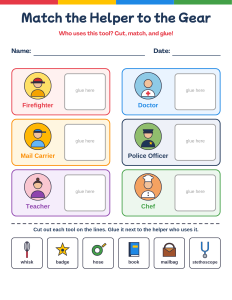
This cut-and-glue worksheet shows six helpers down one side: a firefighter, doctor, mail carrier, police officer, teacher, and chef. Kids cut out pictures of a hose, stethoscope, mailbag, badge, book, and whisk, then glue each of these tools next to its owner.
Cutting builds hand strength, and matching builds early reasoning.
Talk through each choice as your child works, asking why a chef needs a whisk or what a doctor hears through a stethoscope. Those short conversations teach more than the glue ever will.
2. Where Do They Work?
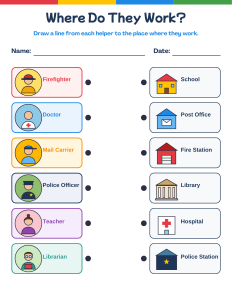
Kids draw a line from each helper to a building: a fire station, hospital, post office, police station, school, and library. This sheet connects each job to a place, which is an early geography skill. It also prepares kids to spot these buildings on a walk or drive.
Try a follow-up field trip without leaving the car by pointing out the post office or fire station on your next errand. Ask who works inside, and let your child be the expert who knows the answer.
3. Trace the Job Names
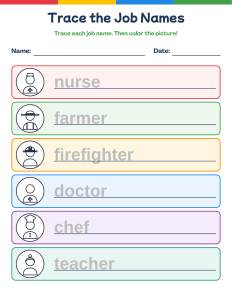
This literacy worksheet pairs a picture of each helper with the job name in dotted letters. Kids trace words like “nurse,” “farmer,” and “firefighter,” then color the picture. The repeated shapes build letter formation while the pictures support word recognition.
Keep this activity short for younger kids, since tracing two or three words is plenty for a preschooler who is still building grip strength. Kindergartners can finish the full sheet and try writing one word without the dots.
4. Count the Construction Gear
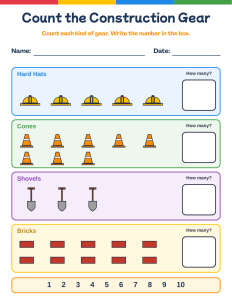
Here the construction worker takes the lead. Kids count hard hats, cones, shovels, and bricks, then write the number in a box. The sheet covers numbers 1 through 10, which matches the CDC milestone of counting to 10 by age 5.
Before starting, explain what builders actually do on the job.
5. Who Do I Ask for Help?
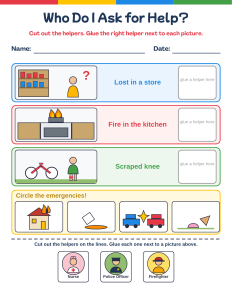
This safety sort shows simple scenes, like a lost child in a store, a kitchen fire, and a scraped knee. Kids cut out helper pictures and glue each one to the scene where that person would help. The last row asks kids to circle which scenes are emergencies.
Use this worksheet to start a bigger talk about 911. The federal 911.gov guide to calling 911 points out that knowing when to call matters just as much as knowing how.
KidsHealth also recommends that parents teach kids to say “nine-one-one” rather than “nine-eleven,” since a scared child may hunt for an “11” key that doesn’t exist.
6. My Community Helper Report
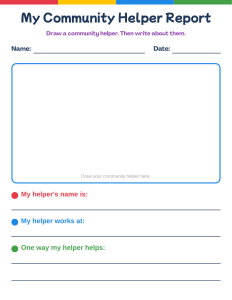
This worksheet has a box to draw a helper and lines for two or three sentences. Kids write the helper’s name, where they work, and one way they help people. It fits first graders best, though kindergartners can dictate while an adult writes.
The report becomes more meaningful when kids interview a real person, like a neighbor, grandparent, or school nurse who can answer three simple questions. Kids feel proud presenting what they learned, and the helper usually enjoys the attention, too.
How to Run a Community Helpers Theme Week
A theme week gives the worksheets a story to live inside. You don’t need formal lesson plans, just a loose order that moves from meeting helpers to practicing what they know. Here is one simple sequence that works for most families.
Day 1: Meet the helpers. Read a picture book about neighborhood jobs and ask your child to name every helper they spot. Finish with the matching page. Keep the first day light so the whole theme feels like play.
Day 2: Explore the places. Complete the “Where Do They Work?” page, then take a short walk or drive to find one of those buildings. When you wave at a mail truck or peek into the fire station, the worksheet suddenly feels true.
Day 3: Make and trace. Pair the tracing page with a hands-on project from our preschool community helpers crafts that turn pretend play into learning. Pick one craft, like a paper firefighter hat or mail carrier bag, so kids have something to wear all week. A craft also gives busy hands a break from pencils, which makes it one of the easiest preschool activities to pair with tracing.
Day 4: Build and count. Do the construction counting sheet, then build a “job site” with blocks. Let your child be the construction worker who decides where each piece goes. Count the blocks together as you clean up.
Day 5: Stay safe. Finish with the safety sort and a calm talk about emergencies. End by writing or dictating the helper report. Celebrate the week by having your child share the report with a family member or classmate.
Role-play ties the week together, especially when you swap roles often so your child is the doctor one minute and the patient the next. Switching perspectives like this builds the same skills covered in these flexible thinking activities for preschoolers.
Adapting Community Helper Activities for Older Grades
The same community helpers activities grow with your child. Older students already know what a firefighter does, so shift the focus from naming helpers to understanding how a community works. The goal moves from recognition to research.
1st Grade to 3rd Grade
Students in these grades can write full sentences and ask thoughtful questions. Expand the helper report into a short interview project with five questions and a drawing.
A 3rd grade student can also compare two community workers, like a nurse and a veterinarian, using a simple two-column chart.
4th Grade and 5th Grade
Older kids can study how communities pay for and organize services. Ask students to map every public service within a mile of home, from the library to the water treatment plant.
A 5th-grade student can research one career using the Bureau of Labor Statistics’ Occupational Outlook Handbook and report on training, duties, and work settings.
This is also a good age to discuss goods versus services. A baker sells goods, while a teacher provides a service, and kids can make a simple craft sorting card for each job they study.
Sorting helpers into these groups connects the community helpers theme to basic economics.
Using Community Helper Worksheets at Home & Homeschool
Families use these pages in different ways. Some parents print one worksheet for a rainy afternoon, while others build a full unit around them. Both approaches work, as long as the worksheet stays tied to a real conversation.
Homeschool resources often lean on narration and real-world observation. If you follow that style, the Charlotte Mason method guide shows how to blend short lessons with outdoor time and living books.
Community helpers fit that approach well, since the lessons happen on every errand.
Paper worksheets have one big advantage over interactive worksheets on a screen. Kids practice cutting, gluing, and pencil grip, which no screen can build. Save any screen activity for review, and let paper do the heavy lifting for learning.
Whatever setting you use, follow your child’s lead. The best resource is often right outside your door. If they fixate on garbage trucks for a week, lean in and let sanitation workers take center stage.
Curiosity is the best teacher a young learner has, and community helpers give it plenty to work with.
